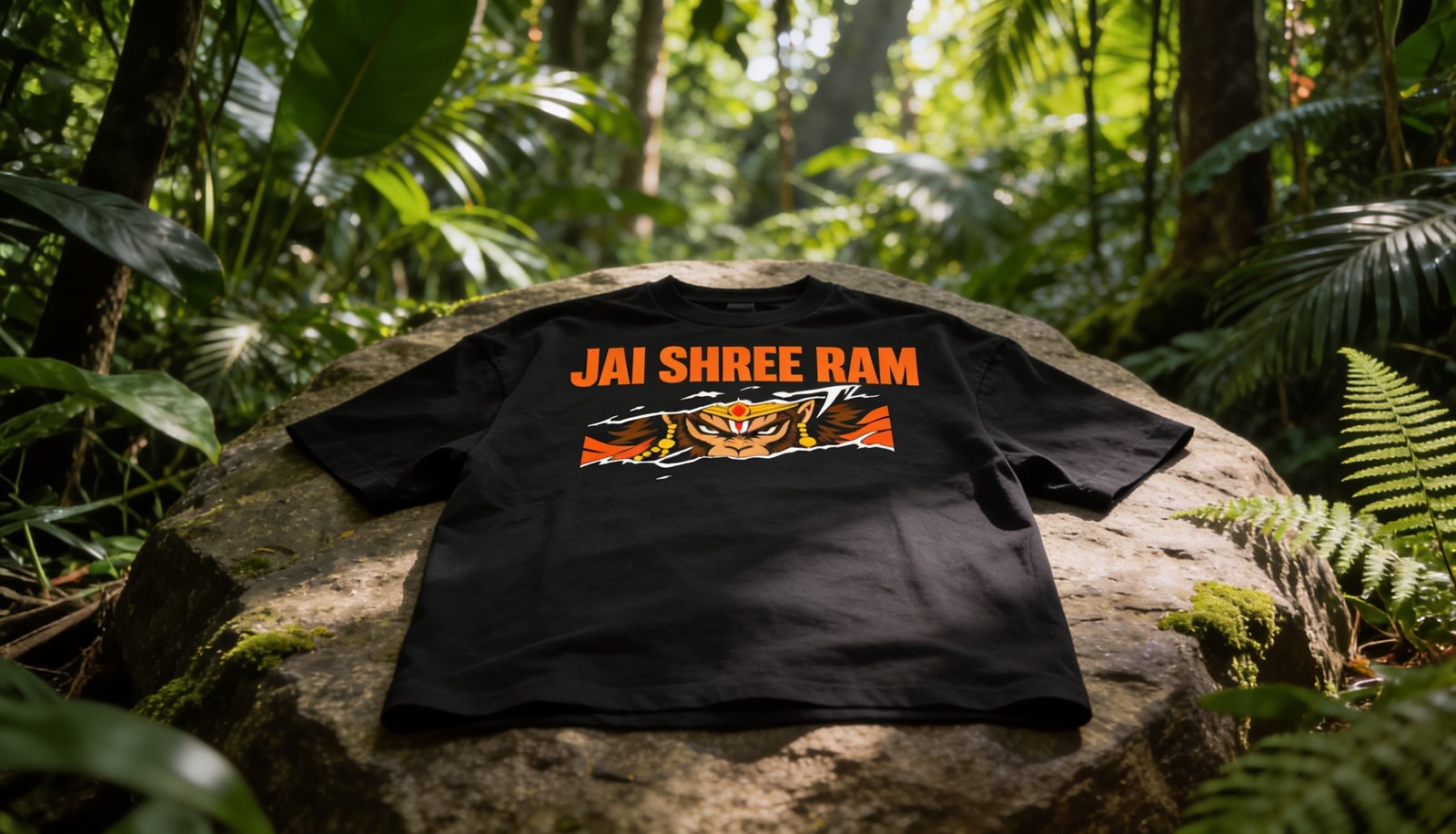
Didn’t think a t-shirt could stop me mid-scroll. But there it was. Some guy in Varanasi, black oversized tee, JAI SHREE RAM blazing orange across his chest, Hanuman ripping through the fabric on the back. No chain. No caption. Just standing there like he owned the footpath.
Saved the image. Still think about it.
A well-made Hanuman tee doesn’t chase attention. It just has it.
Indian streetwear has been building for years and everyone knows it. But something changed lately that’s harder to put into words. It stopped being about the silhouette. Dropped shoulder, wide fit, that’s almost standard now. What people want is something that actually means something. And for a generation that grew up with Hanuman Chalisa saved on their phone for before board exams, sindoor on their fingers at Navratri, baba’s framed Bajrangbali on the wall next to the TV — devotional graphics on fabric aren’t a trend. They’re just familiar.
Why Hanuman T-Shirts Hit Different
Hanuman isn’t a logo. He’s been carrying the weight of an entire civilisation’s belief system for several thousand years before anyone thought to put him on cotton. Strength without ego. Devotion that doesn’t flinch. The kind of fearlessness that doesn’t announce itself.
Every quality streetwear chases — rawness, depth, something real — he already has it. Has had it longer than any brand from Tokyo or New York.
When young Indians started wearing that image on their chest, it wasn’t edgy. It wasn’t political. It was simpler than that: this is ours. And it’s worth showing.
“JAI SHREE RAM” in orange across your chest isn’t typography. It’s 5,000 years of context you’re walking around with. No hollow slogan competes with that.
The Rise of Devotional Streetwear in India
Walk through any college campus in Lucknow, Bhopal, Varanasi. Spend a Sunday at Lajpat Nagar. The Hindu graphic tee sits right next to the anime prints and the band merch. Same pile, same wardrobe.
Three things made this happen. None of them are accidents.
Gen Z got genuinely obsessed with Indian mythology. Not in a school syllabus way. In a “let me explain the actual geopolitics of the Mahabharata” way. Grandparents’ stories became legitimately fascinating. That energy goes somewhere. It went onto fabric.
The art got serious. The old era of gods on 150-rupee bazaar cloth is mostly over. What replaced it is actually good — anime aesthetics colliding with Puranic imagery, brutal typography around Sanskrit text, screen prints that survive real wash cycles. Design that treats the subject with the respect it deserves.
Then the phones. One video of a Ram bhakt looking clean in a devotional fit gets three million views on Reels. Then another. Then another. Devotional streetwear in India became a real category because real people made it look real, not because a brand told them to.
What to Look for in a Hanuman T-Shirt (And What to Avoid)
Not all of them are worth your money. Straight talk:
Fabric Weight
160 GSM feels like a grocery bag after two washes. For a graphic covering real surface area — front text, back artwork — you want at least 240–260 GSM. The weight gives the print something to grip and lets the tee hang right instead of clinging in weird places. It matters more than most people admit.
Print Quality
Screen printing is the answer for a detailed Hanuman graphic. Goes into the fabric, not on top of it like a sticker. DTG looks fine in product photos. Wash it three times. A proper screen print survives years of cold-water washes inside-out. Touch both and you immediately know the difference.
The Silhouette
Drop-shoulder oversized is not a regular tee sized up. The cut is built differently from the shoulder seam down. The back graphic — usually the centrepiece on a Hanuman tee — needs to lay flat. A big regular shirt bunches, twists, and ruins the artwork placement fast.
What to Skip
DTG on anything below 200 GSM peels within months. Sublimation prints bleed on orange and saffron tones — exactly the colours that matter here. And anything described as oversized that is clearly just a larger regular-fit shirt. You know the moment you put it on.
How to Style a Hanuman T-Shirt in 2025
The graphic does the talking. You don’t need to add more on top.
Everyday
Black cargos or wide-leg joggers. White sneakers. One chain, or nothing. Works on men and women because the drop shoulder reads differently on different bodies and both versions look right. Don’t overthink it.
Festival season — Navratri, Hanuman Jayanti, Ram Navami
Straight-cut saffron or off-white pants. Rudraksha mala. Bridges devotional and fashion without landing awkwardly on either side. Photographs well too, which matters for obvious reasons.
As a gift
If you have a Ram bhakt in your life — sibling, friend, parent — a quality Hanuman tee is more personal than a mug or a wall poster. Rakshabandhan, bhaiya dooj, birthday. Or just because you saw it and thought of someone. That’s enough.
The Vibrant Wolf Jai Shree Ram Terry Tee
The Vibrant Wolf Jai Shree Ram Oversized Terry T-Shirt is the tee that made me write this. 260 GSM terry-knit cotton blend. Actual weight. The kind where you feel the fabric before you even look at the print.
Front: JAI SHREE RAM in orange with speed-line energy that reads from across a street. Back: Bajrangbali breaking through the fabric, golden crown, fierce gaze, saffron hues, in that anime-meets-devotional style that’s all over Indian graphic tees right now. The back graphic is the showpiece. It’s not subtle.
True drop-shoulder cut. Unisex. Multiple colourways. ₹1,199. For the fabric and print quality, it’s not a hard decision.
Wearing Your Devotion
People who didn’t grow up in this culture sometimes read a Hanuman tee as a statement. A performance.
It isn’t.
The person wearing JAI SHREE RAM on their chest isn’t making an argument. They’re wearing something that already belongs to them. That’s a different kind of energy and you can feel it when you see it in person. No explanation needed.
Indian streetwear is still working out its own language, what it looks like when it stops borrowing from Western or Japanese aesthetics and just draws from its own well. The Hindu graphic tee will be part of that for a long time. Not as a trend. As something that was already there.
Frequently Asked Questions
What is a Hanuman t-shirt?
A Hanuman t-shirt is a graphic tee with artwork of Lord Hanuman, usually combined with devotional text like “Jai Shree Ram” or “Bajrang Bali”. They’ve become a real category in Indian streetwear, worn as fashion and as a genuine expression of devotion. The good ones use serious graphic design on proper fabric, not a rushed print on cheap cotton.
Is it respectful to wear a Hanuman t-shirt as daily fashion?
Most people within the culture don’t find it complicated. Wearing a quality Hanuman tee in your everyday wardrobe is widely accepted across India. It reads as identity and pride, not disrespect. Daily wear is generally fine and increasingly common.
What GSM should a Hanuman oversized t-shirt be?
240 to 280 GSM. Below that the tee loses structure, the print suffers, and it won’t survive a season of real wear. 260 GSM is a good target. Heavy enough to drape properly and hold a screen print the way it needs to.
Where can I buy a Hanuman t-shirt online in India?
Vibrant Wolf makes the Jai Shree Ram Oversized Terry T-Shirt. 260 GSM, Hanuman rip-through back graphic, Jai Shree Ram front print, true drop-shoulder cut. Available in multiple sizes and colours with free delivery across India.
Can women wear Hanuman graphic tees?
The drop-shoulder oversized cut is genuinely unisex. It reads differently on different bodies and both work. Women pair it with wide-leg pants, cargos, layered over shorts. Works well as festival wear during Navratri or Hanuman Jayanti too, especially with saffron or off-white bottoms.